Imagine hiring one of the nation’s top lawyers to defend you in a criminal case, then eviscerating your privilege protections when you upload information to Claude.
That’s what happened in United States v. Heppner. In February, Judge Jed S. Rakoff of the Southern District of New York sided with the government in a criminal case seeking to compel discovery of 31 documents the defendant produced through Anthropic’s Claude. Bradley Heppner, a former executive charged with securities and wire fraud, had input data into Claude and then shared the outputs with his lawyers. He used the platform to prepare reports outlining defense strategy and arguments about the facts and law after learning he was a target of a federal investigation.
The government seized the materials during a search of Heppner’s home. Now they can use them at trial.
Why the Court Said No to Privilege
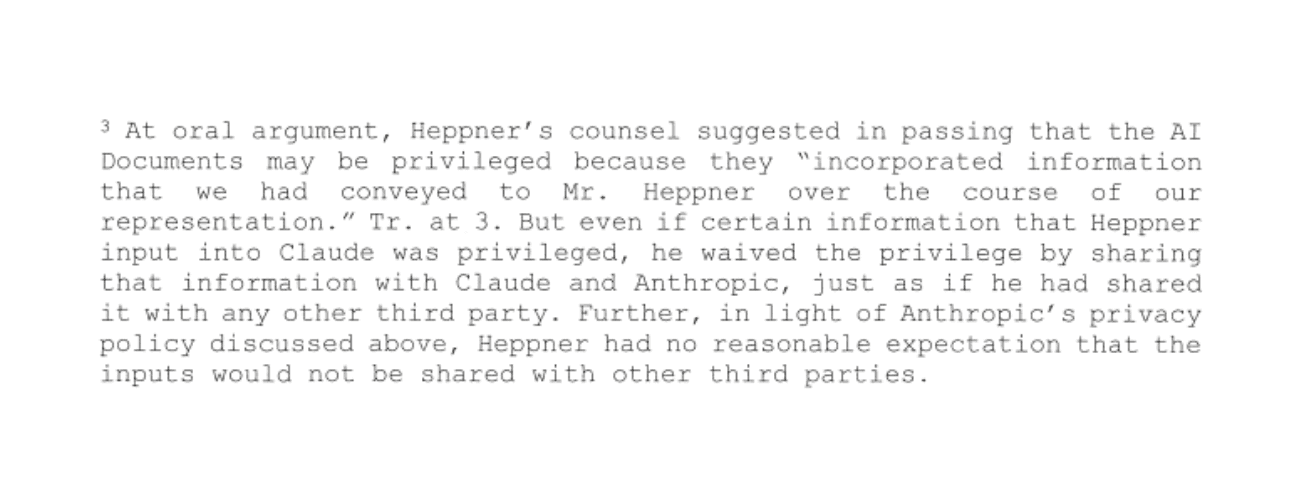
Judge Rakoff ruled the AI chats were not due privilege protections. Even if they incorporated information from his lawyers, the AI chats were not communications between an attorney and client and there was no reasonable expectation of confidentiality.
Attorney-client privilege protects (1) communications between an attorney and her client (2) kept confidential (3) for the purpose of providing or obtaining legal advice. The court found Heppner’s Claude conversations failed all three elements.
First, Claude is not an attorney. The court emphasized that all recognized privileges require “a trusting human relationship” with “a licensed professional who owes fiduciary duties and is subject to discipline.” No such relationship can exist between a user and an artificial intelligence platform.
Second, there was no confidentiality. Claude’s privacy policy expressly permits Anthropic to collect user inputs, train on them and disclose data to third parties including government authorities. Users consent to these terms. That destroys any reasonable expectation of privacy, the court held.
Third, Heppner didn’t use Claude to obtain legal advice. He used it on his own volition, without attorney direction. What matters for privilege is whether Heppner intended to get legal advice from Claude. Claude itself disclaims providing legal advice and recommends consulting an attorney.
The work product doctrine didn’t apply either because the materials were not prepared by or at the behest of an attorney. Heppner’s counsel confirmed the documents were created without their direction and didn’t reflect their strategy at the time.
The Consumer AI Problem
This case comes in the context of consumer AI tools, specifically Claude by Anthropic, and is dependent on those facts. Most public tools offer no confidentiality protections and expressly state that they use data inputs to train their models.
According to the decision, sharing privileged information with a consumer AI platform is the same as sharing it with any other third party. Privilege is waived.
Had Heppner’s counsel directed him to use Claude, the analysis may differ: Judge Rakoff suggested the platform could have acted “as a lawyer’s agent within the protection of the attorney-client privilege.” Enterprise AI tools with confidentiality protections may also support a different result. But that’s a question for another case.
Takeaways
AI is great, but it is not your lawyer. When dealing with legal matters, especially high stakes, tread carefully.
Work through an attorney and keep communications confidential.
If facing an investigation or litigation, don’t process privileged information through consumer AI platforms.
Don’t use AI to brainstorm legal strategy on your own.
If AI tools are appropriate for your matter, use enterprise-grade platforms vetted by counsel.
Adopt policies and implement trainings for your business regarding the proper use and misuse of AI.
Judge Rakoff’s ruling is a first on this topic and not without controversy. Many have questioned the rationale and why this holding wouldn’t extend to other software or communications tools. Expect more cases addressing AI and its impact on legal as use of these technologies accelerates.